
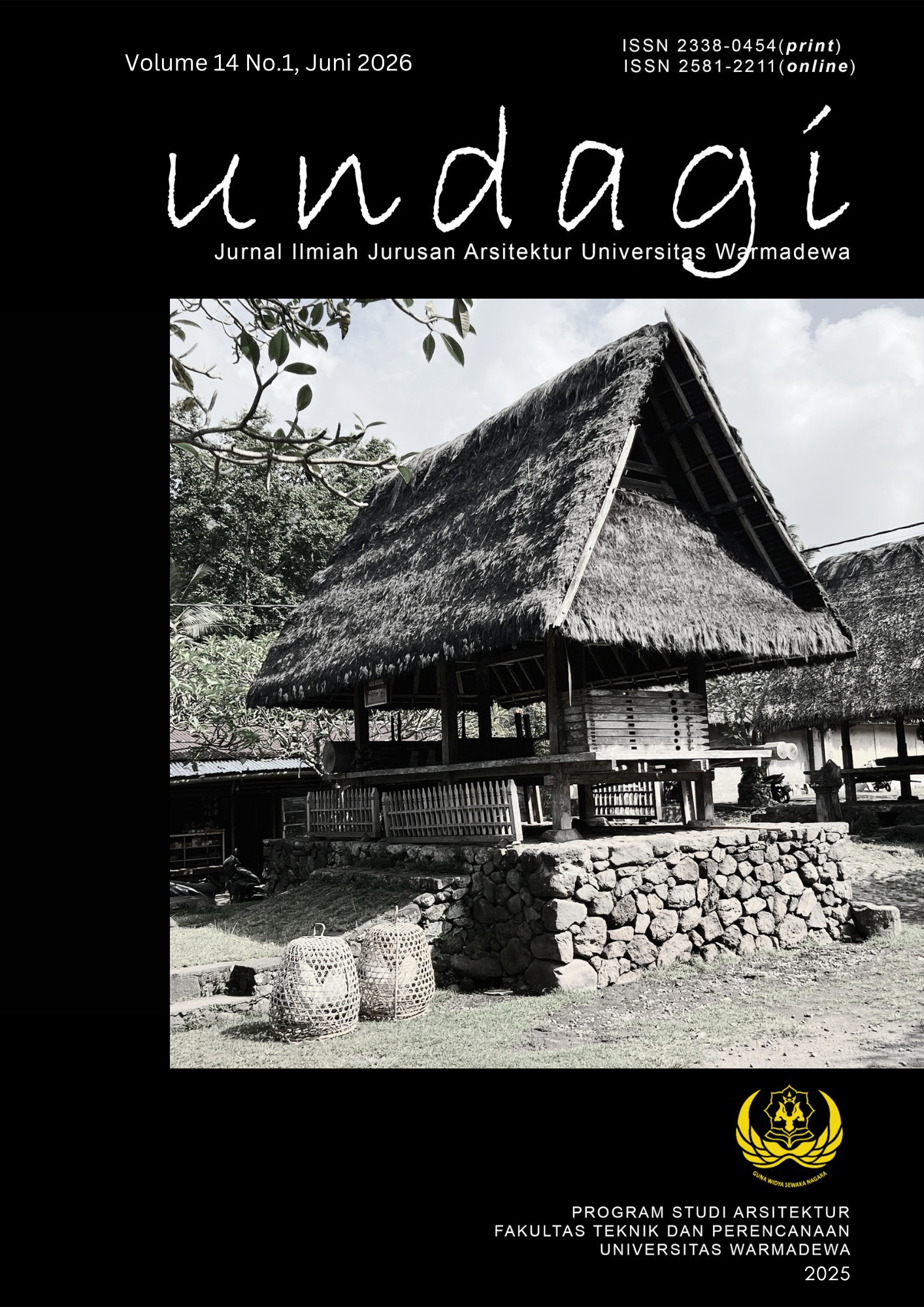
Perencanaan Dan Perancangan Fasilitas Penunjang Wisata Di Kampung Adat Ratenggaro Desa Umbu Ngedo Kecematan Kodi Bangedo Kabupaten Sumba Barat Daya Nusa Tenggara Timur
Bahasa Indonesia
DOI:
https://doi.org/10.22225/undagi.14.1.15025.119-127Keywords:
tourism support facilities, Ratenggaro Traditional Village, Umbu Ngedo Village, Kodi Bangedo District , contextual architecture, cultural tourismAbstract
Ratenggaro Traditional Village, located in Umbu Ngedo Village, Kodi Bangedo District, Southwest Sumba Regency, East Nusa Tenggara, is a cultural tourism destination with great potential through the presence of Uma Kalada traditional houses, megalithic stone tombs, Marapu traditions, ikat weaving, and coastal panoramas. The increase in the number of tourists each year has not been supported by adequate tourism support facilities, such as information centers, parking areas, accommodation, culinary areas, and cultural performance spaces. This condition causes tourism activities to not run optimally and has the potential to reduce tourist comfort. The planning and design of these tourism support facilities aims to provide tourism facilities that are able to accommodate reception, education, exhibition, accommodation, commercial, and recreational activities in an integrated manner while maintaining the cultural values ??and character of Ratenggaro Traditional Village. The design approach uses a contextual architectural theme with the concept of Harmony with Nature and Culture, namely creating harmony between buildings, the natural environment, and the culture of the indigenous community. The methods used include field observation, interviews, documentation, literature studies, precedent studies, and site analysis. The design results are in the form of visitor center facilities, homestays, weaving exhibitions, weaving craft centers, souvenir centers, food courts and amphitheaters designed to follow the spatial patterns of traditional villages and the character of traditional Sumba architecture. The shape of the building adapts the Uma Kalada traditional house with the use of natural materials such as wood, bamboo, natural stone, and reeds to harmonize with the surrounding environment. This design is expected to improve the quality of tourism services, support the preservation of local culture, and improve the economy of the Ratenggaro Traditional Village community in a sustainable manner.
References
Amos Rapoport. (1969). House form and culture. Prentice-Hall.
Badan Pusat Statistik Kabupaten Sumba Barat Daya. (2024). Kabupaten Sumba Barat Daya dalam angka 2024. BPS Kabupaten Sumba Barat Daya.
Bela Winne, Sopiah. (2020). Arsitektur Vernakular Uma Mbatangu Sebagai Identitas Arsitektur Tradisional Sumba Timur. Jurnal Arsitektur Nusantara, Vol. 12, No. 2, hal. 115–126.
Kementerian Pariwisata dan Ekonomi Kreatif Republik Indonesia. (2021). Pedoman destinasi pariwisata berkelanjutan. Kemenparekraf RI.
Kementerian Pariwisata Republik Indonesia. (2021). Rencana Induk Pembangunan Kepariwisataan Nasional (RIPPARNAS) 2010–2025. Jakarta: Kemenparekraf.
Loot, Gerald, W. (Juni, 1989). The Effect of Inquiry Teaching and Advance Organizers Upon Student Outcomes in Science Education. Journal of Research in Science Teaching, 5 : 10 : 437–451.
Lukman, Solihin. (2018). Uma Mbatangu: Rumah Tradisional Sumba dan Nilai Filosofisnya. Jurnal Arsitektur dan Budaya Lokal, Vol. 7, No. 1, hal. 45–58.
Pitana, I. G., & Pitanatri, N. M. (2023). Pariwisata Perdesaan: Konsep, Karakteristik, dan Pengembangan Berkelanjutan. Jakarta: Penerbit Universitas Indonesia.
Peraturan Daerah Kabupaten Sumba Barat Daya Nomor 2 Tahun 2020. Tentang Rencana Tata Ruang Wilayah Kabupaten Sumba Barat Daya Tahun 2022–2042. Pemerintah Kabupaten Sumba Barat Daya.
Rahardjo, B. (2017). Pelestarian Arsitektur Tradisional Indonesia dalam Pengembangan Pariwisata Budaya. Jurnal Pariwisata dan Budaya, Vol. 5, No. 2, hal. 77–89.
Rencana Tata Ruang Wilayah Kabupaten Sumba Barat Daya Tahun 2022–2042. (2020). Peraturan Daerah Kabupaten Sumba Barat Daya Nomor 2 Tahun 2020.
Downloads
Published
How to Cite
Issue
Section
License

This work is licensed under a Creative Commons Attribution-ShareAlike 4.0 International License.
The copyright will be filled by the author if the manuscript has been received and ready to be published and the author will get a letter of acceptance and evaluation of the manuscript from the reviewer as proof of the manuscript has passed the peer-reviewer






_032.jpg)
_033.jpg)
