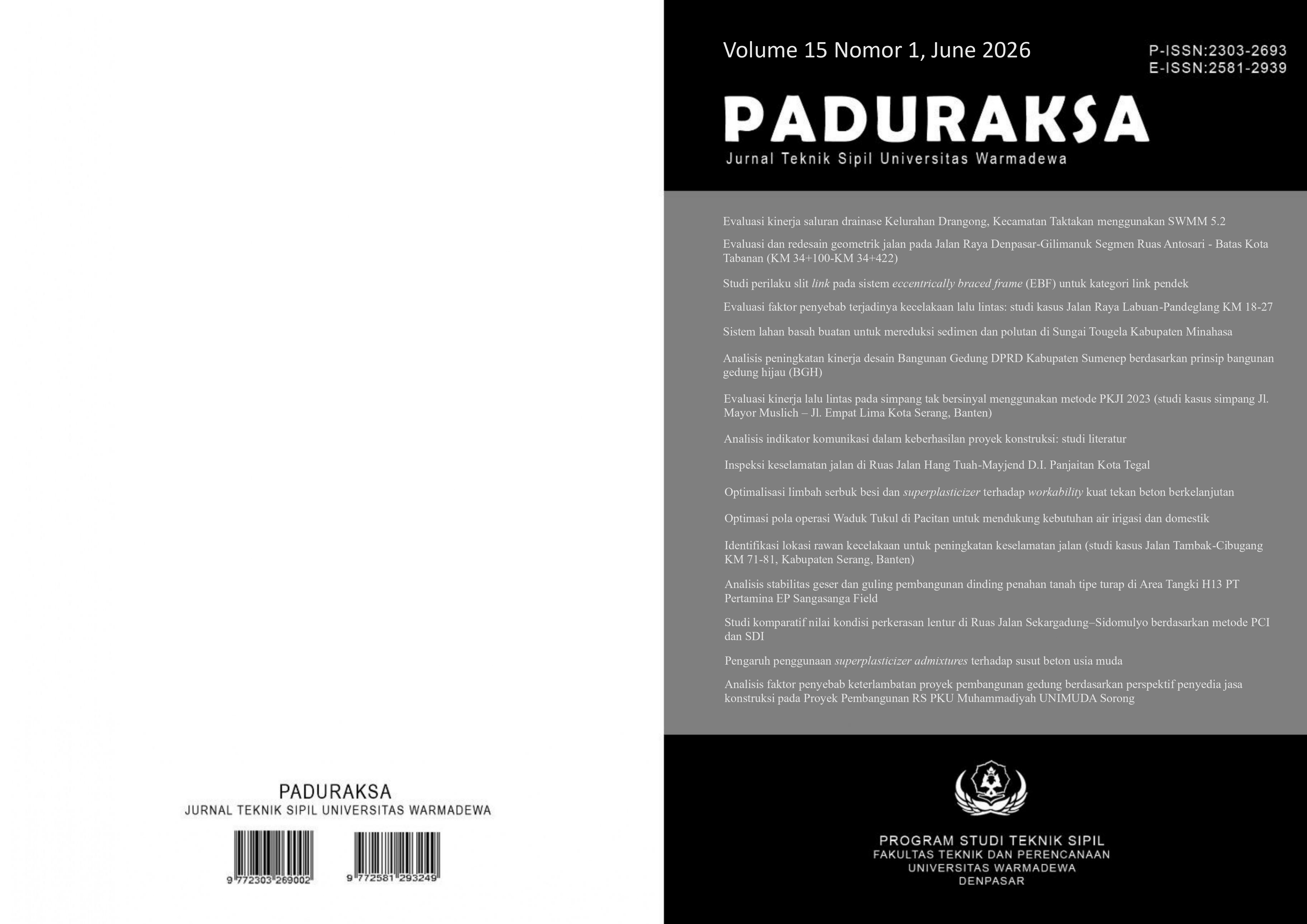
Analisis peningkatan kinerja desain Bangunan Gedung DPRD Kabupaten Sumenep berdasarkan prinsip bangunan gedung hijau (BGH)
DOI:
https://doi.org/10.22225/pd.15.1.14506.53-64Keywords:
BGH, energy, madya, planning, PUPRAbstract
The implementation of Green Building (BGH) has become an important strategy for improving resource efficiency and supporting sustainable development in the construction sector. Although BGH regulations are mandatory for state-owned buildings in Indonesia, empirical evidence on the effectiveness of design revisions in enhancing building performance during the technical planning stage remains limited. This study evaluates the effectiveness of regulation-based design revisions in improving Green Building performance, quantifies performance changes, and identifies the assessment aspects that most influence BGH achievement. A regulatory-based performance assessment with a before–after comparative case study design was applied to the Sumenep Regency DPRD Building. Building performance was evaluated using the official BGH assessment system established under Minister of PUPR Regulation No. 21/2021 and Ministerial Circular No. 01/SE/M/2022. Performance changes were measured by comparing the initial and revised design scores using absolute and relative improvement indicators across seven BGH assessment aspects. The results indicate that the BGH score increased from 70 points (42.4%) to 124 points (75.2%), upgrading the building classification from non-compliant to the Madya Green Building category. The improvement was mainly driven by energy efficiency measures, including optimization of building orientation, lighting, and air-conditioning systems, while water efficiency showed only limited progress. These findings demonstrate that regulation-based design revisions not only improve compliance with BGH requirements but also function as a strategic mechanism for enhancing sustainability performance from the planning stage. This study contributes a regulatory-based comparative evaluation approach for quantitatively assessing design revision effectiveness and identifying the dominant factors influencing Green Building performance in regional government buildings.
References
Ayu, I., Widhiawati, R., Putu, I., Sanjaya, A., & Karitna, N. M. (2023). Penerapan Bangunan Gedung Hijau Pada Proyek Konstruksi Di Gianyar. Jurnal Spektran, 11(2).
Demami, A., & Ningsih, E. (2023). Penilaian Greenship Gbci Dalam Penerapan Tepat Guna Lahan Di Indy Bintaro Office Park. RUSTIC Jurnal Arsitektur, 3.
Fanani, A. R. (2023). Redesain Gedung Flat dosen muda Blok-N11 ITS Surabaya Dengan Mempertimbangkan Aspek Green Building PERMEN-PUPR 2021. Jurnal Vokasi Teknik Sipil.
Fauzan Amin, M., & Rosdiana, W. (2019). Implementasi peraturan Menteri Pekerjaan Umum dan Perumahan Rakyat tentang bangunan gedung hijau (Studi pada Badan Perencanaan Pembangunan Kota Surabaya). Garda Rujukan Digital, 7(5).
Firdha, U. T. (2018). Implementasi Konstruksi Hijau dalam Proyek Bangunan Gedung Menggunakan Model Assessment Green Construction (Studi Kasus: Proyek Apartemen Grand Sungkono Lagoon Tower Caspian Surabaya). In Repository Universitas Jember.
Firmansyah, A. R., Soetjipto, J. W., & Wiyono, R. U. A. (2024). Redesain Perancangan Gedung untuk Memenuhi Standar Bangunan Gedung Hijau Berkelanjutan Berbasis BIM. Journal of Ikatan Ahli Manajemen Proyek Indonesia, 02(1).
Habibi, R., Carlo, N., & Rahmat. (2025). Penilaian Kinerja Bangunan Gedung Hijau Pembangunan RSUD Tanjung Redeb Berau. Jurnal Konstruksia, 16(2).
Ichsan, Z. M. (2023). Studi Indikator Green Construction Pada Proyek Konstruksi Bangunan Gedung. In Universitas Islam Sultan Agung (Number).
IEA. (2019). 2019 Global Status Report for Buildings and Construction. In Global Status Report.
Istri, M. P. I., Zaika, Y., Negara, K. P., Solimun, & Agung Wibowo, M. (2025). Comparative Study of Project Delivery System: Impact on Green Building Performance and Certification in Indonesia. Environmental Research, Engineering and Management, 81(4). https://doi.org/10.5755/j01.erem.81.4.38483
Kussumardianadewi, B. D., Latief, Y., Trigunarsyah, B., Rarasati, A. D., & Widiani, W. (2024). Development of Work Breakdown Structure (WBS) in High-Rise Office Buildings using Green Retrofitting based on GBCI and Minister of PUPR Regulation No. 21 of 2021 to Improve the Quality of Resource Planning. Civil Engineering and Architecture, 12(2). https://doi.org/10.13189/cea.2024.120207
Lagalgarin, A. H., Purwandito, M., & Lisa, N. P. (2023). Penilaian Kinerja Bangunan Gedung Hijau Pada Gedung Fakultas KIP Universitas Samudra. Jurnal Arsitektur ARCADE, 7(2). https://doi.org/10.31848/arcade.v7i2.3126
Maharani, M. P., Iq, T., & Maghfuri, S. (2025). Analisis Tingkat Penerapan Green Building Pada Gedung Fakultas Kehutanan UGM Berdasarkan Aturan GBCI ( Green Building Council Indonesia ). Nasional Teknik Sipil.
Nailah Yasmin, S., Khairulnisa, V., & Nafiah Putri, W. (2024). Evaluasi Penilaian Kinerja Bangunan Gedung Hijau (Bgh) Pada Menara Bank Rakyat Indonesia (Bri) Medan. Prosiding Konferensi Nasional Social & Engineering Polmed (KONSEP), 5.
Nurman, T. R. (2021). Analisa Penerapan Gedung Bangunan Hijau pada Tahap Pelaksanaan Konstruksi. Syntax Idea, 3(10). https://doi.org/10.46799/syntax-idea.v3i10.1388
Peraturan Pemerintah Republik Indonesia Nomor 16 Tahun 2021 Tentang Peraturan Pelaksanaan Undang-Undang Nomor 28 Tahun 2002 Tentang Bangunan Gedung, Sekretariat Negara (2021).
Peraturan Menteri Pekerjaan Umum Dan Perumahan Rakyat Nomor 21 Tahun 2021 Tentang Bangunan Gedung Hijau, (2021).
PNUMA. (2020). 2020 Global Status Report for Buildings and Construction - Executive Summary. In Global Status Report.
Prabowo Sulistiawan, A., Arif Maryanto, D., Ilham Aprizal, M., & Fathur Rachman, F. (2022). Penilaian Sumber dan Siklus Material Arsitektural dalam GBCI pada Gedung Kuliah Bersama Institut Pertanian Bogor (IPB). Jurnal Arsitektur TERRACOTTA |, 3(2).
Praptomo, N. E. (2024). Penerapan Konsep Bangunan Gedung Hijau (Bgh) Pada Rumah Susun Tenaga Pendidik Ugm. Seminar Ilmiah Arsitektur, V.
Priyanto, M. R., Sudaryanto, A. I., Taurano, G. A., & Abda, J. (2024). Penilaian Kinerja Bangunan Gedung Hijau Pada Tahap Pelaksanaan Konstruksi. Konstruksia, 15(April).
Rosyita, D., Khoirunnisa, S., Farihah, N., Wibawa, A., & Arsitektur, P. (2023). Penilaian Kinerja Bangunan Gedung Hijau Kawasan Kampus 4 UPGRIS dari Aspek Ruang Terbuka Hijau. In Science And Engineering National Seminar (Vol. 8, Number 8).
Safrini, Y. D. Y., Aminuddin, K. M., Usman, A. P., Ramadhani, R., & Septriansyah, V. (2025). Penilaian Kinerja Bangunan Gedung Hijau Pada Tahap Perencanaan Teknis Melalui Aspek Efisiensi Penggunaan Energi di Rumah Inti Tumbuh Tahan Gempa (RITTA) Kota Prabumulih. Bearing?: Jurnal Penelitian Dan Kajian Teknik Sipil, 10(2). https://doi.org/10.32502/jbearing.v10i2.10456
Sulistiawan, A. P., Maryanto, D. A. M. A., Aprizal, M. I., & Rachman, F. F. (2022). Penilaian Sumber Dan Siklus Material Arsitektural Dalam GBCI Pada Gedung Kuliah Bersama Institut Pertanian Bogor (IPB). Jurnal Arsitektur TERRACOTTA, 3(2). https://doi.org/10.26760/terracotta.v3i2.6795
Surat Edaran Menteri Pekerjaan Umum Dan Perumahan Rakyat Nomor 01/SE/M/2022 Tentang Petunjuk Teknis Penilaian Kinerja Bangunan Gedung Hijau (2022).
UNEP. (2022). Global Status Report for Buildings and Construction: Towards a Zero emission, Efficient and Resilient Buildings and Construction Sector. Nairobi. In Global Status Report 2022.
Yogananda. (2024). Kajian Penerapan Efisiensi Energi Masjid Agung Dharmasraya, Sumatera Barat. Sigma Teknika, 7(1).
Downloads
Published
Issue
Section
License
Copyright (c) 2026 Masmulyadi; F.Rooslan Edy Santosa

This work is licensed under a Creative Commons Attribution-ShareAlike 4.0 International License.
Authors who publish with this journal agree to the following terms:
1. Authors retain copyright and grant the journal right of first publication with the work simultaneously licensed under a Creative Commons Attribution-ShareAlike 4.0 International (CC BY-SA 4.0) that allows others to share the work with an acknowledgement of the work's authorship and initial publication in this journal.
2. Authors are able to enter into separate, additional contractual arrangements for the non-exclusive distribution of the journal's published version of the work (e.g., post it to an institutional repository or publish it in a book), with an acknowledgement of its initial publication in this journal.
3. Authors are permitted and encouraged to post their work online (e.g., in institutional repositories or on their website) prior to and during the submission process, as it can lead to productive exchanges, as well as earlier and greater citation of published work (See The Effect of Open Access).